
The Power of Reframing: Changing the Frame of a Negotiation
5-minute read
The way you present a situation influences how the other party interprets it and which solutions they consider possible. The same agreement can be seen as a one-off transaction or the beginning of a relationship; as a cost or an investment; through the lens of price or value; with a focus on the next quarter or the next few years.
Before you sit down to negotiate, ask yourself: What frame is the other party using to view this conversation? And what frame would help both of us better recognise the value of an agreement? Sometimes, the most decisive move in a negotiation is not making a new proposal, but changing how the problem is viewed.
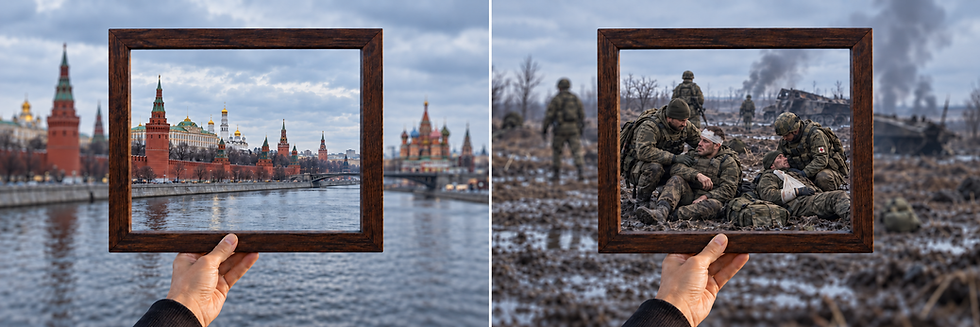
AI-generated illustration. Changing the frame allows you to determine which part of reality we focus on.
On 23 September, addressing the UN Security Council, Polish Foreign Minister Radosław Sikorski offered an example of reframing. Speaking to Russia, he shifted the focus from its ability to prolong the war to its ability to achieve its objectives. He pointed out that Ukraine had halted Russia’s advance despite having a much smaller economy, and compared the size of Russia’s economy with those of Poland, Europe and NATO. He then summed up his message in one sentence: “You can still kill a lot more people, but you cannot win.”
Sikorski put forward a different narrative: rather than presenting Russia as a power capable of prevailing, he argued that continuing the war meant accumulating further losses without achieving its objective. His closing words reinforced that idea: “Tell your boss: Enough is enough.” In doing so, he sought to change the question: if the objective is not being achieved, what is the point of continuing to pay the price?

Radosław Sikorski addressing the UN Security Council, 2025. Photo: Polish Ministry of Foreign Affairs / Gov.pl, CC BY 3.0 Poland.
Sikorski’s example is interesting because it shows that reframing does not mean changing the facts. It means changing the frame through which those facts are interpreted.
We can also change the frame in a business negotiation. If a client approaches the conversation solely in terms of a discount, we can broaden the perspective: what would a delay cost? What value does reducing risk bring? What service commitments or longer-term commitments could form part of the agreement? Changing the frame is not about avoiding the subject of price. It is about ensuring that the decision takes account of everything at stake.
Seven Ways to Change the Frame of a Negotiation
1. Challenge the other party’s frame before making your case
If you accept the other party’s frame, even to defend yourself, you risk arguing on their terms. Sikorski begins by challenging the Russian minister’s account, which described the events in Kyiv in 2014 as a “bloody coup”. To do so, he draws on his personal experience. He explains that he was there alongside the German and French foreign ministers, denies that a coup took place and offers his own account of how Yanukovych lost power. Before debating Lavrov’s conclusions, he challenges the starting point of his narrative.
2. Give meaning to the facts
Sikorski lists actions attributed to Russia: drone attacks, airspace violations, cyberattacks, sabotage and covert operations. He then brings them together under a shared interpretation: “These are not isolated incidents. It’s a pattern.” They cease to be separate episodes and become part of a pattern.
Something similar can happen in negotiation. Faced with five different requests, we could respond to each separately, or identify what they have in common: “We are not discussing five independent concessions. We are discussing how to share the risk between the two parties.” That shifts the focus of the conversation.
3. Change the frame of the negotiation
The implicit frame Sikorski challenges is: Russia can continue the war because Russia has power. He changes the question: it is not about how long Russia can keep fighting, but about what it has achieved after all that time. To construct this new frame, he first introduces time: more than twelve years trying to conquer the Donbas and more than four trying to conquer Kyiv. He then compares Russia’s GDP with that of Ukraine, Poland, Europe and NATO. In doing so, he invites his audience to compare the time invested and the resources available with the results achieved.
In a business negotiation, this would be like saying: “Let’s not evaluate this strategy solely on the basis of what we can still invest in it. Let’s look at the results of the investment we have already made.” This completely changes the yardstick used to measure power.
4. Use contrast to reinforce your frame
After presenting the data, Sikorski uses contrast to strengthen his reframing: “You can still kill a lot more people, but you cannot win.” The force of the sentence lies in the contrast: you can… but you cannot… He acknowledges that Russia retains the ability to cause considerable harm, while questioning whether that will enable it to win the war.
In negotiation, acknowledging a reality on the other side can be more effective than rejecting it outright. For example: “You can secure a price reduction today, but that does not guarantee a lower total cost.” The first part concedes a point; the second invites the other party to assess the decision against a different criterion.
5. Question what appears inevitable
Sikorski calls the conflict a “war of choice” and states that Russia can stop it at any time. This changes the frame: he presents the war as a decision rather than something inevitable.
In negotiation, we also hear positions presented as fixed:
“It’s company policy.”
“We can’t pay any more.”
“That’s how the market is.”
“We’ve always done it this way.”
A useful question is: “Which part of this is a constraint, and which part is a decision we could reconsider?” It does not assume that everything is negotiable, but it helps uncover where there is room to move forward.
6. Introduce the long-term consequences
After discussing war, power and resources, Sikorski shifts the time horizon: “Stop destroying Russia’s future.” He is no longer focusing only on the current cost of the war, but on what Russia could lose if it continues.
Changing the time horizon can also transform a negotiation. A proposal may appear attractive if we consider:
This quarter’s results, but not those of the coming years.
The initial price, but not the total cost.
The immediate concession, but not the precedent it sets.
Before negotiating, it is therefore worth asking: “What happens if I change the time horizon through which we are evaluating this agreement?”
7. Address your audience directly
Sikorski closes with a sentence directed at Sergey Lavrov: “Sergey, I know you’re listening. Tell your boss: Enough is enough.” He deliberately changes his register, tone, rhythm and addressee. He moves away from institutional language—“representatives of the Russian Federation”—and addresses a person by name: “Sergey”. He shifts from geopolitical concepts, GDP and NATO to a personal instruction, and from paragraphs of argument to a brief, direct request. That shift makes the closing memorable. The argument may be complex; the conclusion should be clear and direct.
When a conversation gets stuck, it may be worth asking whether the problem lies in the arguments or in the frame through which both parties are assessing them.
Full text of Sikorski’s address: Gov.pl



Comments